Attachment Based Therapy Denver, CO

What is Attachment Based Therapy?
Attachment theory is the largest body of research on healthy relationships. This theory categorizes relationship behavior and provides insight into why we are the way we are in relationships. It helps identify where your relationship behaviors came from, help you predict how you may act in different interpersonal situations, and provides guidance on how to heal and change your relationship patterns.
Our therapists at ACTW are well trained in attachment theory and utilize it as the foundation of our therapy approach. We join you in the exploration of how your past relationships have shaped your attachment style. Attachment wounds are created when we experience pain or neglect from the people we care most about.
Attachment-based therapy will help you discover and heal old attachment wounds, so that they no longer impact current and future relationships. If you feel like you are stuck in your relationship patterns and want to learn why and stop the cycle, attachment-based therapy is strongly recommended!
Authentic Connections Therapy and Wellness provides attachment-based therapy in Denver and Greenwood Village, with virtual sessions across Colorado and PSYPACT states. Our doctoral-level therapists use attachment theory as the foundation of their work — helping you understand your attachment style (secure, anxious, avoidant, or fearful), heal old attachment wounds, and build secure, satisfying relationships. Book a free 15-minute consultation to get matched with a therapist.
What Are the Four Attachment Styles
Attachment theory has divided the different types of attachment into four categories. Early research thought that we developed our attachment style in the first few years of life, but later research discovered that important relationships throughout our life can shape our attachment styles. The four types are: Secure, Anxious, Avoidant, and Fearful.
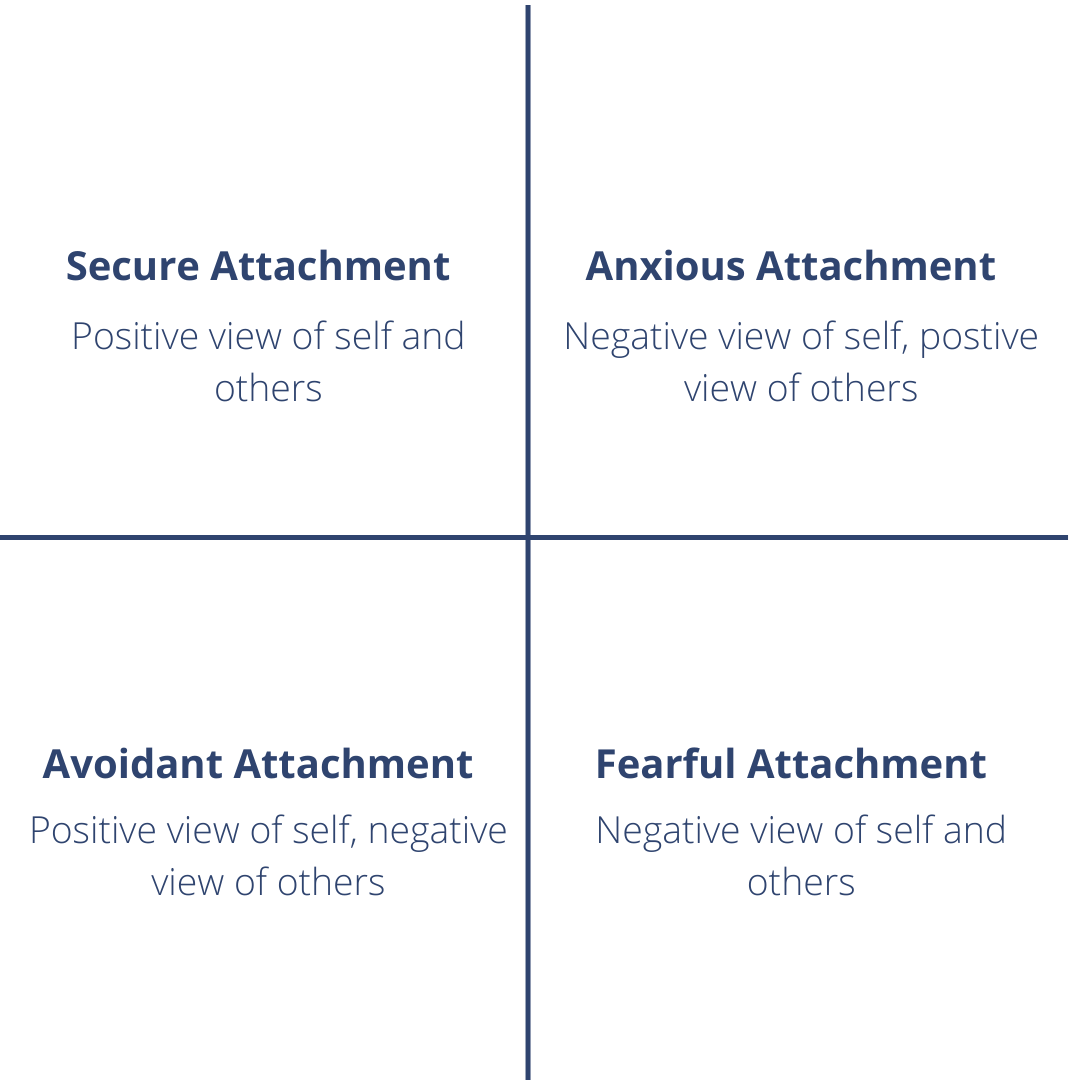
Secure Attachment Style
A secure attachment style categorizes healthy relationship behaviors. People who have experienced healthy relationships in the past and have learned that they are lovable and others are trustworthy. People with this attachment style are able to easily identify their emotions and needs and find it easy to communicate them to others. They typically have very satisfying relationships and low levels of depression and anxiety.
Signs of a Secure Attachment Style
This is the attachment style that represents the healthy way of building relationships. Most people fall into this category. Attachment styles, similar to other personality styles, are not black and white. If you have a secure attachment style that doesn't mean that you always react in a secure way. There are plenty of individual differences and unique situations that can trigger different types of attachment behaviors.
Having a secure attachment means that in most situations you have healthy relationship coping. If you are wanting to react in more secure ways, attachment-based therapy is a great way to heal past attachment wounds and create healthy relationship skills.

Anxious Attachment Style
An anxious attachment style categorizes the relationship behavior of a person who questions their own self-worth and views others as "having it all together." People who have experienced inconsistency in relationships learn to worry about others leaving and worry about their worthiness to keep others' love and attention. This may look like a parent or romantic partner is loving one moment and absent/cold the next.
Signs of an Anxious Attachment Style
Someone with this attachment style may feel insecure in relationships and may seek attention and love in unhealthy ways. They may stay in unhealthy relationships for too long, may push people away to test if they truly love them, or be on hyper alert towards signs of rejection or emotional/physical abandonment. People with this attachment style often are people pleasers and lose themselves in relationships in an attempt to try and avoid rejection. They may externally process, be more outwardly emotional, and report higher rates of relationship anxiety.
Someone who has this attachment style deeply values relationships and is willing to seek help and support to enhance their interpersonal skills. In couples, the anxiously attached partner is often the initiator of the couple's therapy. If you feel like your relationship anxiety is inhibiting connection, or you worry about how codependent behaviors negatively impact your relationships, attachment-based therapy can help decipher your triggers and help you react more securely.

Avoidant Attachment Style
An avoidant attachment style categorizes the relationship behavior of a person who feels the weight of the world and has learned that others are unreliable. People who have experienced absent parents (parents who had to work often, parents dealing with their own mental health issues, or emotionally/physically neglectful) or romantic partners that were unreliable.
Signs of an Avoidant Attachment Style
Our culture deeply values an independent person, the "lone wolf" who can take care of themselves. So, it might not be immediately obvious to someone with an avoidant attachment style that their relationship behaviors are inhibiting connection and closeness. Often someone with this attachment style will be able to make surface connections but struggle to be vulnerable and create deeply satisfying relationships. If you have this attachment style past partners may have said you are "hard to get to know" or they didn't know if you were interested in them.
People with this attachment style feel uncomfortable when others get too close and may worry that they will have to compromise too much in a relationship. When someone with this attachment style feels lonely or upset they often retreat into themselves, work, or other hobbies to self-soothe. If this sounds familiar and you want to learn how to better connect and be vulnerable attachment-based therapy will greatly help this growth area.

Fearful Attachment Style
A fearful attachment style categorizes the relationship behavior of a person who both strongly desires and fears connection. Often someone who has this attachment style has experienced both love and abuse in the same relationship. When this happens, it can cause confusion about what is healthy and unhealthy. Often people with this attachment style discuss the difficulty of trusting their "gut" in relationships.
Signs of a Fearful (Disorganized) Attachment Style
If you connected with the description of both an anxious attachment style and an avoidant attachment style, you likely fall into the fearful attachment style category. Due to the fearful attachment having both avoidant and anxious tendencies, someone with this attachment style will exhibit "push-pull" behaviors. This can include desiring deep closeness and then pushing their partner away. While research suggests that this is the rarest type of attachment style, clinically, we see that most people have both avoidant and anxious behaviors depending on the situation.
When a person with a fearful attachment style is in a relationship with an anxiously attached person they may display more avoidant attachment behaviors... When they are in a relationship with someone who is more avoidantly attached they may display more anxious attachment behaviors. As stated above there are more intricacies than you have this attachment style or that attachment style, so it is important to find a therapist who can help you better understand your unique interpersonal style.

Frequently Asked Questions about Attachment-Based Therapy.
-
Attachment-based therapy helps you understand how your family, past relationships, and impactful events in your life shape the interpersonal cycles you may be stuck in right now. Your therapist uses a relational approach to help you explore patterns you’ve development to protect yourself that are showing up in ways that are hurting you in the present. Your therapist can help be your accountability partner to point out when these patterns are emerging and guide you through ways you can do things differently so that you aren’t stuck in the same loop.
-
Attachment-based therapy is especially effective for adolescents and families. Teens often struggle with independence, identity, and connection, and attachment-based work can help communication between parents and teens. Many unhelpful patterns are developed during these years and attachment-based therapy can help change these cycles before that have a lasting impact on future relationships. Learn more about teen counseling here.
-
Attachment-based therapy is likely the best therapeutic approach after a break-up. Breakups often reactivate old attachment wounds, including feelings of abandonment, rejection, or insecurity. Attachment-based therapy helps you understand why certain relationships or endings feel particularly painful, and how to heal those wounds, and help prevent you from experiencing a similar relationship trauma in the future. This can be especially helpful for those who have a difficult time moving on after a relationship ending. Learn more about break-up recovery here.
-
Attachment styles are like relationship personality styles and describe how we connect, communicate, and handle closeness and independence in relationships. The four main attachment styles are: Secure, Anxious, Avoidant, and Fearful. Recognizing your attachment style can transform how you approach love, friendship, and your family. In therapy, you’ll learn how to create secure attachment patterns, where vulnerability feels safe and relationships become sources of strength, not stress.
-
Attachment Based-Therapy costs vary depending on the provider’s experience and can cost between $135 and $225 a session. To learn more about if this fits in your budget, schedule a phone consultation below with one of our practice owners to find the right fit.
-
Yes. Attachment styles are learned patterns, not fixed traits. Research on 'earned secure attachment' shows that consistent, corrective relational experiences, including the relationship with your therapist, can shift anxious, avoidant, or fearful patterns toward security. It takes time and practice, but this is one of the primary goals of attachment-based therapy. We have an assessment we give you at the beginning of therapy that we can periodically re-test to see how your attachment style has changed.
-
The descriptions on this page are a good starting point, and online quizzes can point you in a general direction. But attachment is more nuanced than a single label — many people show different patterns in different relationships. We will provide you with an attachment assessment that provides a dynamic view of different relationships and the levels of your attachment security or insecurity. Through therapy, we will learn how your attachment style developed, how it is showing up in relationships now, and changes you can make to become more secure.
-
Emotional distance is often a sign of an avoidant attachment style, a learned pattern where closeness starts to feel unsafe or engulfing, so your partner pulls away to self-regulate. It usually isn't a measure of how much they care about you. Understanding whether this is avoidant attachment, and how your own attachment style reacts to the distance, is the first step to changing the cycle. Dr. Woolford wrote a full guide on this: Why Does My Partner Keep Me at Arm's Length? Do They Have an Avoidant Attachment Style?
Is Attachment Based Therapy in Denver, CO Right for You?
We are here to help you on your journey to finding a deeper meaning in your relationships! If you find yourself consistently forming unhealthy relationships, our skilled therapists at Authentic Connections Therapy and Wellness can help you understand the behaviors behind those unhealthy choices. Follow the steps below to get started.
We encourage you to get to know a little bit about our therapists, their specializations, and their credentials. Get to know our therapists here.
If you think Attachment Based Therapy is for you, reach out to us! You can use our convenient online therapy scheduling.
Begin the exciting journey of understanding your relationships to forge a lasting, healthy, and fulfilling relationship!
We hope to hear from you soon!
Attachment Based Therapy Blog Posts








8 Highly Recommended Attachment Based Therapists in Denver
-

Dr. Annalise Floody
-

Dr. Courtney Phillips, Psy.D.
-

Dr. Courtney Crouse
-

Dr. Rachel Hughitt, Ph.D.
-

Dr. Veronica Scherbak Ph.D.
-

Dr. Rebekah DePretis Psy.D.
-

Dr. Celeste Tinkoff Psy.D.
-

Karina Ernst, MA
In-person and Remote Options for Attachment Based Therapy in Denver, CO
Our offices are conveniently located on the North (Lower Highlands) and South (Denver Tech Center) ends of the Denver metroplex. Can’t make it into the office? No worries – we’ve got you covered with virtual therapy.
Our Denver Tech Center (DTC) office is located at 5350 S Roslyn St in Greenwood Village. It shares a parking lot with the Landmark near Comedy Works South, Hapa Sushi Grill and Sake, and JING Denver.
Our Lower Highlands office is located at 2460 West 26th Avenue in Denver. It is right on i25, across the street from the downtown REI, and a few blocks from the Empower Stadium, The Downtown Aquarium, and Elitch Gardens